
Women Rising with the Tides of Restoration
Updated: Apr 6
Rebalancing power through women-led futures
grounded in community-driven systems

Long before modern economies and borders, human survival depended upon connections to the natural world. We learned to read the tides as they rose and fell, to follow the turning of the seasons, and to move with the migrations that traced life’s pathways through water and land. These rhythms were not abstract forces. They were teachers and they reminded us that survival depended on caring for the systems that cared for us.

They were relationships. The earth was not a resource. It was a provider. A teacher. A living system that demanded reciprocity.
Many Indigenous cultures still hold this understanding. Land is not owned; it is stewarded. Water is not extracted; it is protected. Knowledge is not hoarded; it is passed down through generations, often through women. The mothers, grandmothers, and knowledge keepers. In matrilineal societies across the world, lineage flows through women. So does responsibility. So does memory. These are not systems rooted in domination, but in continuity, structured to protect life rather than extract from it.
And for thousands of years, they worked.
Until they were disrupted.
What replaced them was not evolution, it was imposition.
Colonial expansion, white supremacy, and patriarchal governance did not simply expand power; they reshaped it through force. Entire peoples were enslaved, brutalized, sexually violated, and killed. Knowledge systems were silenced, and life itself was recast as something to be controlled and consumed. These systems are not stable or “natural.” They must be sustained through inequality, upheld by domination and violence. Land became property, control was centralized, and both nature and women were reduced to assets to be managed. The shift was profound.

The earth became something to extract from. Women became something to control. The language mirrors the logic: untouched land to be “claimed,” frontiers to be “penetrated,” wilderness to be “tamed.” The same worldview that strips autonomy from ecosystems strips autonomy from bodies. And the consequences are not theoretical. They are visible in collapsing marine ecosystems, in accelerating climate instability, and in the social systems that continue to concentrate power in the hands of a few (who are often insulated from the harm those systems produce).
We are also seeing, more clearly than ever, how that power has been used. From the exposure of global sexual abuse networks involving powerful men, to the normalization of violence against women and children, to wars waged at a distance where civilian lives become collateral, there is a pattern that is difficult to ignore. When power is concentrated without accountability, it detaches from consequence. Lives become abstract. Systems become indifferent to, and even promote, harm.

This is not an anomaly. It is a feature of a system organized around dominance.
And it is failing.
At the same time, one of the most powerful forces for stability, resilience, and
long-term thinking remains systematically underutilized: Women.
Around the world, especially in coastal and Indigenous communities, women are already doing the work of sustaining life. They manage food systems, maintain social cohesion, pass down knowledge, and adapt to environmental change in real time. Yet they remain underrepresented in formal leadership and largely excluded from ownership in emerging economic systems, including the rapidly growing blue economy. This is not just inequity. It is a structural blind spot.
Across the world, matrilineal and matriarchal systems have long been organizing power differently, shaping who owns land, how decisions are made, and what communities prioritize in their survival.
Because the data is clear: when women are meaningfully included in decision-making, outcomes improve. Economies become more stable. Resources are managed more sustainably. Communities are more resilient. But inclusion alone is not enough. The real shift comes with ownership.
Most marine restoration efforts today focus on repairing ecosystems. They rebuild reefs, restore kelp, and measure biodiversity. But they rarely address who owns the infrastructure, who controls the value, and who benefits over time. Without that, restoration risks becoming another form of extraction – where ecosystems recover, but communities remain excluded.
Reef Life’s model is designed to interrupt that pattern.

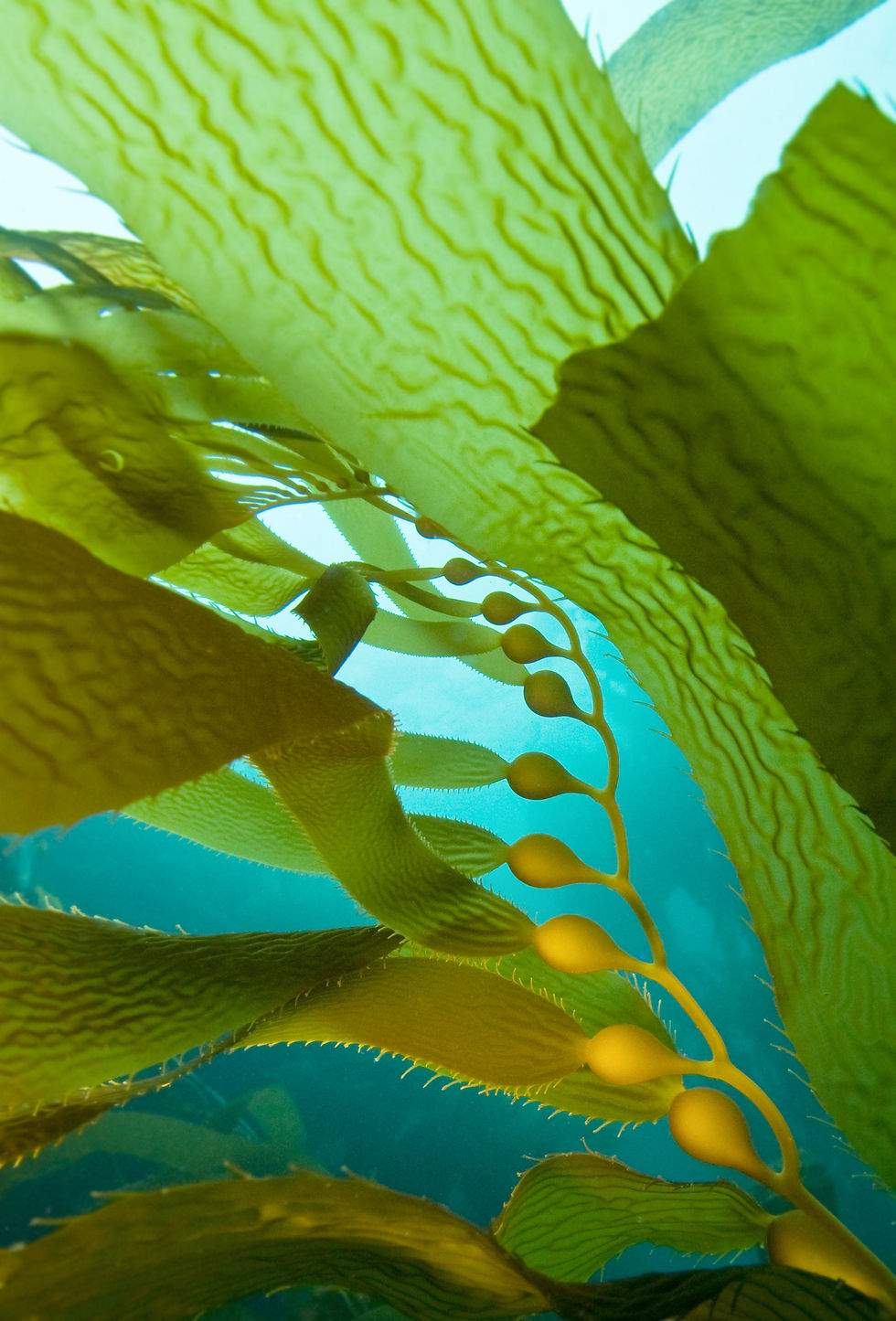
Through the deployment of Oceanite, we restore important marine ecosystems like kelp forests, reef systems, sponge habitats, and shorelines. But the defining feature is not just the restorative technology, it is the structure around it. The infrastructure is owned by the community. What grows from it belongs to the community. The value it generates stays local. This transforms restoration into something fundamentally different: a foundation for long-term, community-held economic power.
And within that system, women are not positioned as labor. They are positioned as leaders and owners.
In South Africa, Oceanite-supported kelp restoration has become the foundation for a women-led consortium that manages harvesting, processing, and product development. Women harvest kelp grown on the Oceanite modules, then transform it into a range of value-added goods including fertilizers, food products, and skincare items. These are not side projects, but small businesses built and operated by the women themselves. The revenue generated from what grows on the Oceanite is not owned by Reef Life or IntelliReefs, but remains with the community, reinforcing long-term stewardship of the marine ecosystems they depend on.

In Madagascar, a similar model is taking shape through sponge cultivation. Women harvest natural sponges that grow on Oceanite structures, carefully clean and process them, and combine them with soaps and essential oils to create high-value bath and body products. These goods are then sold into European and U.S. markets, creating a direct link between local ecological restoration and global economic opportunity.
These are not isolated outcomes. They are signals of what becomes possible when ecological restoration is paired with economic agency. But infrastructure alone is not enough. Transformation scales through connection.
The Blue Ocean Brain Trust links these communities into a global, peer-driven network where knowledge is shared openly across sites. Women mentor one another. Communities exchange strategies. Innovation moves horizontally, not from the top down.

Not extractive, but regenerative. Not centralized, but distributed.
Not competitive, but collaborative.

It reflects something older – and more durable – than the systems currently dominating global markets. In the natural world, we see this pattern clearly. Elephant herds rely on elder females to guide survival through environmental knowledge. Orca pods are structured around matriarchs whose memory determines the group’s success. Even among our closest relatives, bonobo societies are guided by female alliances that rely on social connection to resolve conflict, while chimpanzee societies, which are more male-dominated, are characterized by violence and aggression, patterns that are not unfamiliar in human systems.

There was a time when human societies aligned with this pattern. Before patriarchal systems took hold, many societies were built around the generative power of women, organizing life to protect creation rather than dominate it. What if the path forward is not something we need to invent… but something we need to remember?
Because restoring ecosystems is not just a technical challenge. It is a structural one. It requires rethinking who holds knowledge, who holds power, and who is trusted to lead.
Reef Life’s work sits at that intersection. We work towards not only restoring marine environments, but also restoring the conditions under which those environments can be protected long-term. Through Oceanite, restoration is paired with community ownership, ensuring that the value generated from healthy ecosystems remains local. This opens the door for women-led businesses and sustainable livelihoods that are built on regeneration, not extraction, allowing communities to thrive without compromising the ecosystems they depend on.
If this model continues to grow, the future begins to look different.
Coastal communities are not sites of extraction, but centers of ownership. Restoration is no longer a temporary intervention, but a lasting economic foundation. Women are not brought in as participants, but recognized as leaders who design, manage, and scale systems that sustain both ecosystems and livelihoods. Knowledge moves between communities instead of being locked behind institutions, and solutions evolve through shared experience rather than imposed expertise.
This is not a distant vision. It is already taking shape in communities where restoration is built alongside local ownership and long-term responsibility.
Lasting restoration does not come from outside investment alone. It comes from the commitment and participation of the people who live closest to these ecosystems. It is built through intergenerational knowledge, through relationships with place, and through a shared understanding that the environment is not a resource to use, but a responsibility to care for.
This kind of stewardship cannot be imposed. It must be rooted in trust, in continuity, and in listening. It requires turning back toward the voices that have always held this knowledge. The elders and the matriarchs who have remained connected to land and water, who carry memory, and whose guidance has too often been ignored or suppressed.
The future of the ocean will not be determined by technology alone. It will be shaped by communities who are supported in owning, stewarding, and passing down what sustains them.
The question is whether we are willing to invest in those communities and restore the conditions that allow that knowledge to lead.

Imagine a global network where:
Women own marine infrastructure.
Women mentor women across continents.
Restoration knowledge flows openly.
Coastal wealth remains local.
Girls see marine science as leadership.
The Blue Ocean Brain Trust becomes the
backbone of regenerative blue economies worldwide.
Oceanite powers it. Women lead it.
And together, they reshape the future of the ocean economy.


